
Understanding Active & Reactive Power Sharing in BESS: A Simple Guide

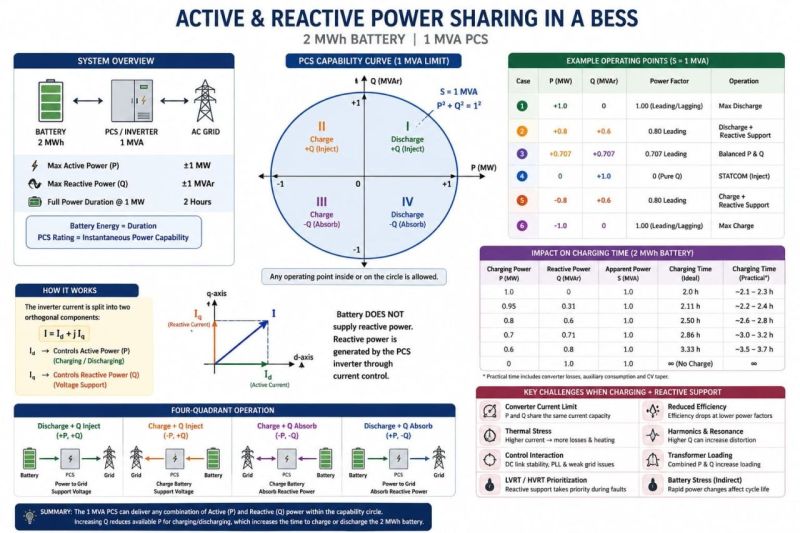
Simple Understanding of Active & Reactive Power Sharing in BESS A BESS has:
- Battery Capacity (MWh) → How much energy is stored
- PCS/Inverter Rating (MVA) → How much power can flow at a time
Example:
- Battery = 2 MWh
- PCS = 1 MVA
So maximum charging/discharging power is about 1 MW, giving:
- 2 hours backup at full load
The inverter shares its capacity between:
- Active Power (P) → Actual charging/discharging power
- Reactive Power (Q) → Voltage & grid support
Their limit is:
P² + Q² = S²
If the inverter provides more reactive power, available active power reduces.
Example:
- 1 MW charging → 2 hours charging time
- 0.8 MW charging + 0.6 MVAr support → charging time increases to 2.5 hours
Reactive power does not consume battery energy directly. It is generated by the inverter for grid stability and voltage support.
That’s why modern BESS can:
- Store energy
- Support voltage
- Improve power factor
- Work like a STATCOM
- Support weak grids simultaneously